
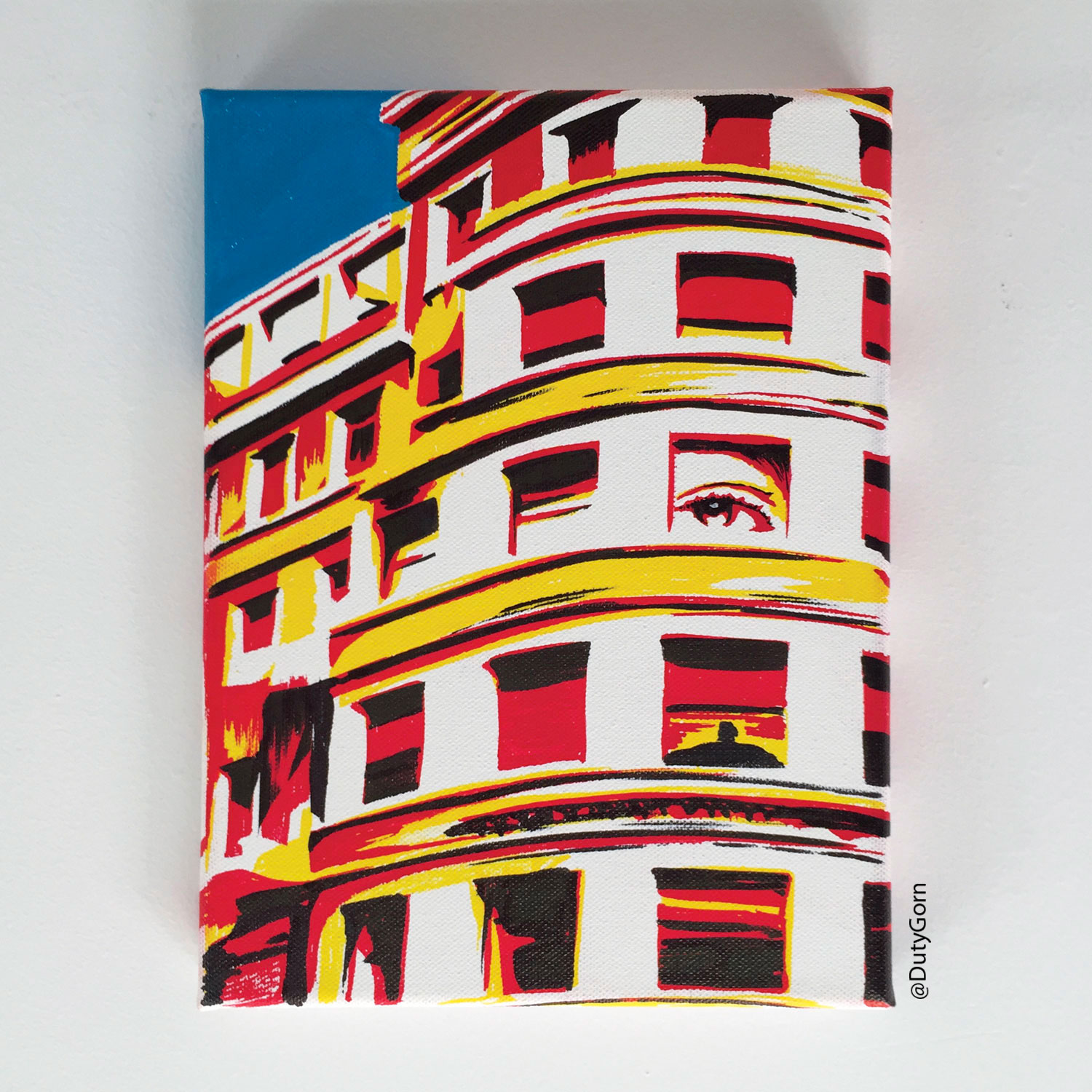
There are moments when the world changes without asking permission. The streets continue to exist, buildings remain where they have always been, windows light up in the evening as they always have, and yet something has broken. In March 2020, it took only a few days for everything we considered normal to suddenly become distant. The city was still out there, but it no longer belonged to us.
Rear Window was born within that suspension. The home, a place of return and protection, slowly became its opposite: a boundary. The walls that until the day before had guarded our intimacy began to define the limits of the possible world. Yellow and red run across the building like a fever, vivid and almost defiant, while behind the windows life remains still, forced to observe what it can no longer reach.
And then there is the eye. It does not simply look outside: it searches. It scans the city as if watching something it fears it might lose. Within that gaze, unease, helplessness, curiosity and a silent form of resistance coexist. Because even when the body is still, the gaze continues to travel. It crosses the glass, wanders through empty streets, imagines people behind other windows and tries to understand when everything will begin again.
Perhaps this was one of the strangest aspects of those days: we were separated and, at the same time, united by the same sense of waiting. Millions of lives enclosed within different rooms were looking towards the same suspended world. The window became a screen, a frontier, a theatre. It was enough to look outside to realise that the city had not disappeared. It was simply waiting.
Rear Window speaks of that condition, but also of something that has always belonged to human nature: the ability to search for an opening when everything seems to be closing in. Behind fear, desire remains. Behind stillness, movement survives. And even when a home begins to resemble a prison, there is still a window through which to imagine the day when the door will finally open again.
“Rear Window” by DutyGorn
Markers on canvas
20 × 30 cm
March 2020
Artwork Information
Series
Portrait
Frontage
Year
2020
Materials
Markers on canvas
Dimensions
20 × 30 cm
Location
Milano, Italy
Exhibited at
Multiverso, Milan
Notes
A female figure emerges from a maze of architectural forms, as if observed through an urban window. Rear Window turns portraiture into a dialogue between space, architecture and human presence.
Themes
Portraiture, Surrealism, Dualism, Architecture, Identity